As a nice present for my Dad for his birthday, I set out to build a more refined version of the envy I built previously.
Inspiration
I was once again inspired by Youtube Shorts (what a terrible way to waste time). I saw a quick clip by Mohit Bhoite about his lunar lander wire frame designs. Really beautiful point-to-point construction! He has his own website, with details on how to build these yourself: here.
I first wanted to build his BLE Satellite, but found that the required I2C 4-digit 7 Segment LCDs are basically unobtainium. They are not available outside Ebay, and shipping from the US only.
Parts
I picked a readily available EA DOGS164W-A Character LCD by Display Visions, located here in Germany. It’s addressable over I2C and very easy to use.
For a low-power all-in-one sensor, I went with the Bosch BME680. It measures Temperature, Humidity, Pressure and approximates CO2 levels. From all these readings, it generates the IAQ, or Indoor Air Quality Index. It’s a number between 50 (good) and 300 (bad) representing the quality of the air.
The platform for controlling all this is the nice!nano, featuring the nRF52840, with an integrated Li-Ion charger. I’m using an old discarded single-use Vape Battery, and soldered a Li-Ion protection circuit to it: the DW02KA. It has all the protections needed for safe Li-Ion operation and required just a single resistor. I covered the unprotected Li-Ion terminals with UV-curable green soldermask.
I tried my best to make the construction look as cool and impressive as Mohit Bhoite makes it look.
There are some things I’ve got to learn about point-to-point construction, but for a first attempt I think it’s more than passable.
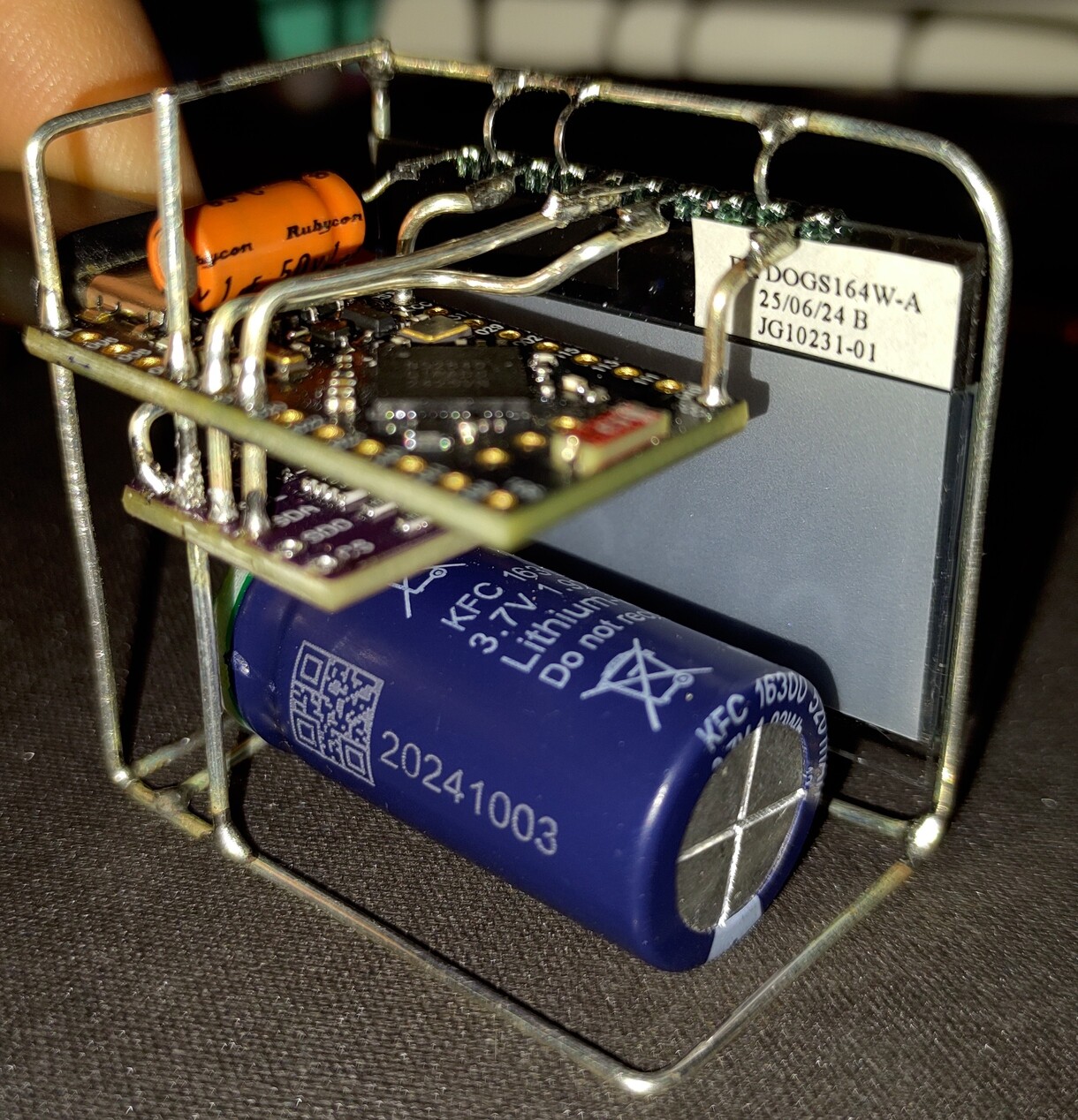 This picture was taken before installing the last parts of the frame, which is connected to Ground.
All other signal wires do not protrude the frame, to make short circuits less likely.
This picture was taken before installing the last parts of the frame, which is connected to Ground.
All other signal wires do not protrude the frame, to make short circuits less likely.
Software
Due to time constraints, I coded the entire project in Arduino, and used libraries for interfacing the LCD and Sensor. It works, but one concern was battery life. On average, the whole circuit draws 1.05 mA. I could certainly do better, but it’s good enough. It’s rechargeable via USB-C.
Quick tests with the same solar panels used in the aforementioned BLE Satellite, suggested that it is not worth it to implement solar charging. The Solar panels were just not strong enough to supply enough voltage and current to keep the device charged, or even to supplement the battery life in a meaningful way.
Final Gadget
It came out great.
A couple of bends in the frame are rounder than I would have liked, but as a first wire bending projects that’s excusable.
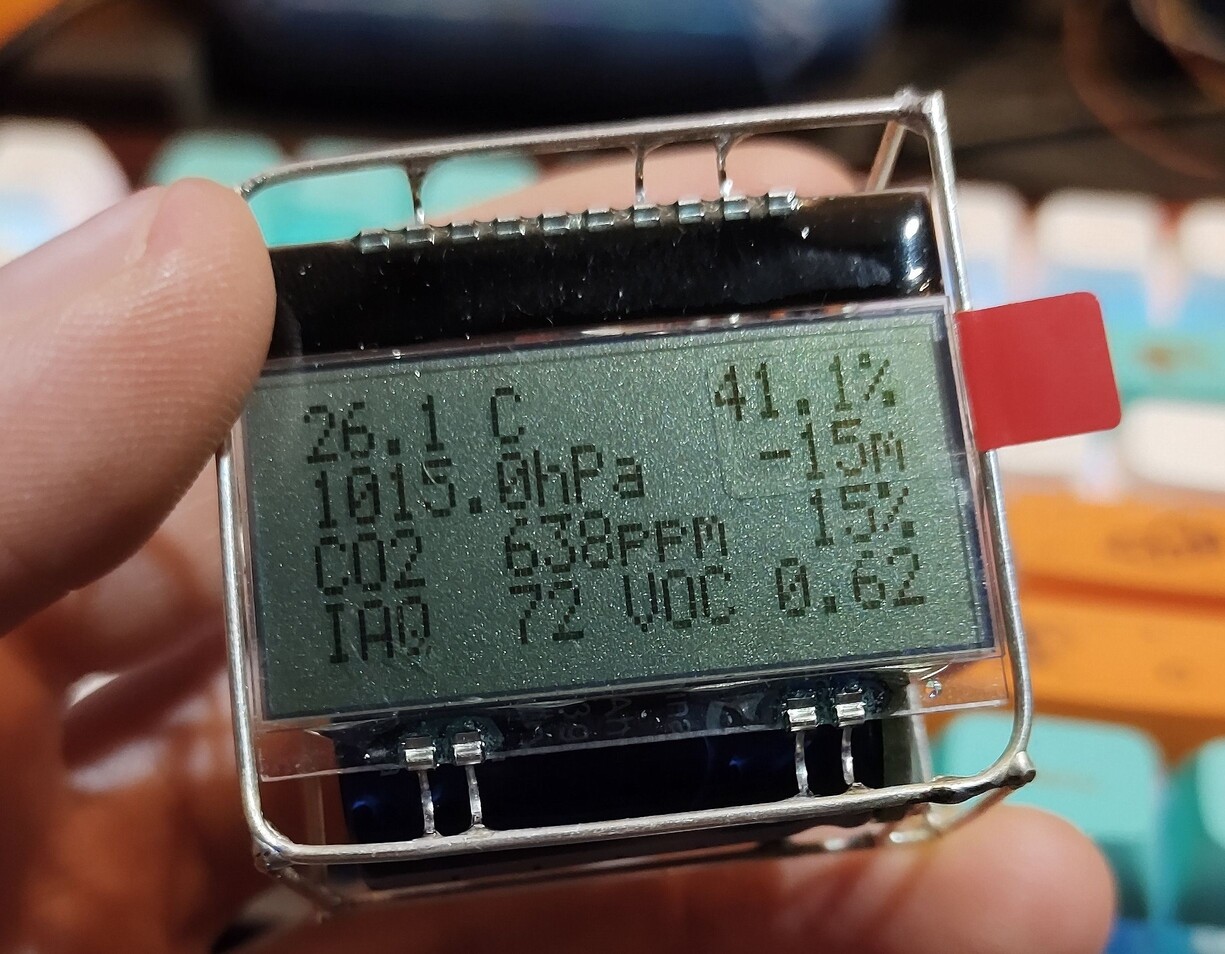
I might want to enable the BT radio for sample collection, and somehow pipe the data into Home Assistant. But so far, I conclude this project completed. My source code can be found in my GitLab: here.